I'm frustrated with a series of short cultural analyses I've read today. It all starts with an essay by William Deresiewicz entitled "Upper Middle Brow," in which the author attempts to identify a strand of culture-production designed to "make consciousness safe for the upper middle class" by "approving our feelings and reinforcing our prejudices." A step above "midcult" (a term I hate and thought had fallen out of fashion), "upper middle brow" consists of cultural products that possess "excellence, intelligence, and integrity," but that "always let us off the hook" by failing to disrupt our assumptions and challenge us. The "us" in question refers to a nearly-new creative class of college- and postgraduate-educated professionals whose tastes verge on the downright literary.
Who is implicated in this sophisticated, stylish, post-ironic pat-on-the-back party? Apparently: Jonathan Lethem, The New Yorker, Wes Anderson, This American Life, Lost in Translation, and GIRLS. Also, "the films that should have won the Oscars." But not all of them—a handy list of midcult artifacts ("peddling uplift in the guise of big ideas") includes Malick's Tree of Life. Who else is on the midcult list? Franzen, Jonathan Safran-Foer, Middlesex. (Just separating Lethem from this company seems a microscopically fine exercise in hairsplitting, and attenuates the explanatory power of the typology.)
So what does Deresiewicz suggest as an antidote? Upper middle brow is, after all, a problem framed in a way that implies a particular solution. The suggestion he offers is that we need a return to an art that will "disturb [our] self-delight", because we are "engorged on our own virtue" and allowed, by our choices of aesthetic consumption, to remain complacent and untroubled.
Showing posts with label Awareness. Show all posts
Showing posts with label Awareness. Show all posts
Monday, November 12, 2012

Friday, November 2, 2012
Hyperbole, in Good Faith
A friend of mine used to accuse me of falling into hyperbole when describing items of interest in my life. “No,” I swore, “I don’t mean to exaggerate, I’m giving you a true record of my experience—it was truly, superlatively [adjective]!” This little essay is an attempt to get at possible motivations for spending big words on little things, while also offering a hesitant typology.
Thursday, October 25, 2012
Steaks on a Plane

"Excuse me, sir, could I please see your boarding pass?"
I looked up from my laptop, instinctively tightening my feet around my bag and placing a hand on my rollaway. A woman in my airline's uniform with disarmingly large Persian eyes stood waiting for my response.
"Um, yeah sure, just a sec."
I handed it to her out of my shirt pocket, and waited to be told that I would need to go back to American Customs Pre-Clearance to sort out the ambiguities I'd inadvertently penned into my information card.
She eyed my ticket. "Please bear with me for a moment, sir." Then she walked away. I closed my computer, watched the desk under the sign for GATE 105, and thought about what a great story I'd have if I were detained in Dublin for the whole weekend by customs agents perplexed by my inconsistent passport use on flights to and from the US.
I ended up with a different story, however. My flight attendant returned and looked at me with her huge eyes. "Sorry about the confusion, sir. You'd gotten an upgrade and we wanted to make sure it was printed on your ticket." She handed me my boarding pass and I looked at it, then back up at her. "Wait a second—I'm sorry, what does this mean?" I must have misunderstood the word printed in place of "Economy" in the lower right corner, next to the almost-certainly misprinted "SEAT 3G". She replied, "It means you are now flying business class." She turned on her heel and walked away. I smiled, caught myself, furrowed my brow, and smiled again, unable to bury my excitement.
So it begins: the story of a wide-eyed midwestern boy's adventure behind the business class curtain.
Saturday, June 9, 2012
The Really Real and the Really, Truly, Indubitably Real
I went for a run today in the rain. By the time I got back to my building the sun had come out. With my contacts in, I was able to see a lot of detail in things that would otherwise be obscured by my glasses. I don't know if crumbled concrete and a rotting white door are proper objects of wonder, but here we are.
I was cooling down, walking and stretching, when my mind quietly seized. In the clouds and trees, even in the brick buildings and cobblestone parking lots, I saw a desert open up. Everything was a flat, consistent plane, each surface equally opaque and continuous with every other. There was a kind of inscrutable hiddenness in everything.
In this state I prayed. I asked God for a sign that this was his work. By the end of my silent prayer, everything had become a surface—not just the sights of things, but their sounds, smells, feels. My mind became a point suspended in something I know not what. I turned around like a baby in utero, looking at a world made strange.
I don't know if God answered my prayer in a way I could understand, but my heightened sense of alienation at least reopened a window that's been shut for a long time. Here's the view, familiar enough: my little brain does its best to dance over the surfaces of things, and is satisfied with a cursory knowledge of the contours they present to me. It cannot, however, open a door into a stone, or touch the life that animates an olive tree. My brain can only gesture at reality at a slant, and ponder it from a distance. Perhaps otherwise it would be consumed—or simply fall silent, like the collapsing body of the man who tried to steady the ark with his bare hand.
Maybe it really is true, that everything we think or say is essentially and most truly about what we cannot think and can never say. Who could know? And could she say it if she did know?
Tuesday, January 17, 2012
Lana Del Rey and the Locus of Criticism
My procrastination ought to make the most sense now, of all times, on account of this being exam week, with my next test slated for Friday afternoon. If a person has four wide-open days until his next objective, it's permissible for him to spend some of that time engrossed in extracurricular subjects, right? Which is my justification for the past 36 hours. Yesterday, after putting a period on the final line of a fifteen-page essay exam, I permitted my mind to fly off to whenever and wherever it wanted. To a noble place, my mind did not deliver me.

Lana Del Rey is probably a familiar name and face to you, if you waste your spare time scanning pop culture and music blogs. She has an EP out (I think?) and is releasing a full-length album at the end of January; she also performed on SNL last weekend and has been getting a ton of media attention, much of which has been negative (even angrily so). The elite, pace-setting members of the indie music scene have come down especially hard on Ms. Del Rey (a stage name), and while I can't speak to the musical criticisms qua musical criticisms, I do find the extra-musical complaints fairly compelling and accessible, because they are not very technical, and very human.
The thing is, 25-year-old Del Rey got her industry sea legs performing under her real name, Lizzy Grant, and when I say industry sea legs, I mean she stumbled between venues for a few years without gaining any real traction with the people who mattered. As competent but somewhat generic musicians are wont to do, she handily evaded commercial success.
But then Lizzy became Lana, and consequently went from being pretty in a cornfield blonde, wholesome, small-town-girl-next-door sort of way to being, well, something else. A collagen-puffed pout sealed her revamped market-ready image, which combines lapsed (and mourned) innocence with a caricaturish femme-fatale vibe and a lot of other things that make me feel weird when I watch her performing or giving interviews.

Music bloggers take real offense, it seems, because she is so clearly sculpted to appeal to denizens of their empire, the pop-indie scene. Her self-aware affectations imply a sort of wink-wink nod to something being parodied, or at least communicate the sort of po-mo playfulness that artists use to give listeners a sense of being in on something together, little cultural co-conspirators that we are. Her videos swing between whimsical and overblown images (Del Rey ensconced in a throne in what appears to be a cathedral, with tigers laying down on either side within arm's reach; Del Rey, bloodied, held in the arms of a muscular tattoo-covered dude with gauged ears, in front of the burning wreckage of their car—I don't see how you could interpret these as anything but self-aware, jokey excesses) and grainy Super 8 "found footage" style montages that evoke powerful nostalgia—even for the mid-2000s, apparently, judging from the inclusion (has to be another wink-wink moment, right?) of a familiar iPod billboard advertisement, nestled between shots of unhelmeted couples riding classic Victory motorcycles.
Even though I haven't the slightest critical chops to justify my saying anything about her music, I will say this: her tracks are, unsurprisingly, perfectly matched to the aesthetics of her persona and brand. The songs I've listened to cultivate a (self-consciously?) retro sensibility, with static-crackling samples of decades-old recordings, kitschy string intros, and moody lyrics that Del Rey delivers with a trademark croon. You may imagine it accurately with the aid of her promotional taglines, which she's apparently used to describe herself during interviews: "a gangster Nancy Sinatra," "Lolita got lost in the hood." As one online commentator points out, these sound a lot more like phrases that were tossed around in a corporate boardroom during a brainstorming session than anything a musician would say about herself off the cuff.

The thing is, though, all of this brand genealogy stuff seems pretty weak, insofar as it's intended as criticism. Successful musicians (perhaps with the exception of those who work exclusively in the studio) are necessarily successful performers—not only of their music, but of themselves—and creating a persona or brand is one way, perhaps the only way, of approaching performance: come up with a character to play, a simple and consumable identity that you can separate from yourself and offer as a commodity to potential listeners, fans, EP purchasers. Bring out a single theme that people can latch on to and associate with you; find an unexplored niche in the pop-cultural landscape and put your stake in the ground. It's one method among many for creating a splash, and I would go so far as to say that it's basically unrelated to the actual quality of the creative product.
But still, some artists leave us with a sense of having gone about this process of cultivating showmanship in a more "authentic" way; their onstage or video versions of themselves seem roughly natural extensions of the personalities we imagine them to exude around their families or their pets. Why does Lana Del Rey still leave such a bad taste in the mouths of so many? Do people really believe themselves to have such psychological insight and moral sensitivity in their assessments of the Del Rey persona's "truthfulness?" Is it just that people think she's a big phony, or could it have a little more to do with in-house resentment? Could it be the attention she's been receiving that other artists and a lot of critics feel is undeserved, based on her questionable talent and minuscule CV and blatant posturing?
Perhaps. But the market is obviously, always, and inherently unfair, and popular success is a cruel mistress to those who would try to court her. Del Rey set out to achieve something that she seems to have achieved, even if it's been a tough slog through bad performances and frequently caustic press that may have required her to give up something of herself. The brand she has constructed is essential to that success, and to call it what it is—manufactured—is to miss the point.
Ah yes, the point. The reason my brain keeps straining to make sense of Lana Del Rey is that frustratingly complicated aspect of her schtick that I mentioned earlier. The arch persona and intimations of irony do lead me to look for the joke, or the parody, or whatever it is that she's doing; I'm having a magnificently hard time trying to figure out the proper locus of criticism, the guiding intention that would establish a context in which her whole act might be evaluated, according to its own goals. I want to "get" the point, and am not content to believe that it's just to generate buzz.
Is it necessary for her to have the sort of determinate aim that I'm trying to uncover? Probably not, and maybe this reveals a weakness of my own in trying to understand music and musicians generally—an inability to be satisfied with a decidedly equivocal play of symbols designed to hazily evoke rather than communicate. Call it a preference; I have a greater appreciation for art that seems to ride a discernible (and criticizable) intention—for lyrics that tell stories, for instance—than art that forces its consumers to cast out feelers for shreds of meaning in purposefully jumbled and even inchoate sets of ideas and images.
Obviously there's a spectrum here, and I don't mean to be reductive, but man do I get annoyed with music and literature that isn't just obscure or difficult, but intentionally, a-priori meaningless in a cynical sort of way. Meet me halfway, creators; I love interpreting in the face of ambiguity and all its attendant tensions, and I find it bracing to bear up under the onslaught of tricks that subvert traditional artistic forms. But I hate finding out that I'm trying to make sense of something that was never meant to be more than packaged gibberish, a glossed-up sneer. Such stuff does exist, and it's angering.
Back to Del Rey. I have my theories. With the lips and the distant look, is she some sort of embodied critique of porny male sexual desire - a sendup of the appearance and attitude of a jaded longtime member of the adult film community, where the obvious artificiality implicates the viewer, as though to ask "is this what you want? A fleshed-out Barbie doll?" This could be the calculated side of a coin that flips to reveal the full-throated rage that characterized the Blood Brothers.
Or, with the grainy montage in "Video Games," is she a sad messenger angel from the past—a 60s flight attendant, somehow simultaneously from the 80s—who contrasts Morning in America in all its apparent sun-shiny resplendence with the grimness of present economic instability? Or, does the same angel sing over this montage only to show the fickleness of nostalgia and the impossibility of remembering rightly, who means to tell us that our idea of the past is a lie?

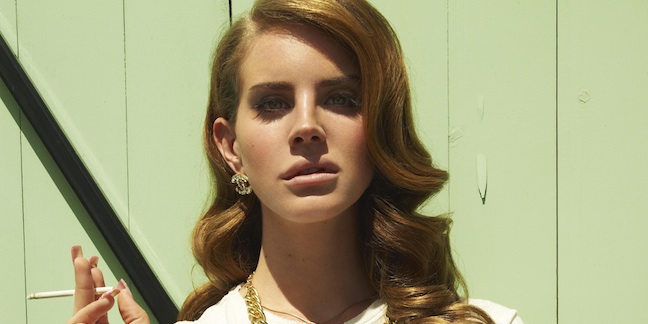
What are you looking at?
Lana Del Rey is probably a familiar name and face to you, if you waste your spare time scanning pop culture and music blogs. She has an EP out (I think?) and is releasing a full-length album at the end of January; she also performed on SNL last weekend and has been getting a ton of media attention, much of which has been negative (even angrily so). The elite, pace-setting members of the indie music scene have come down especially hard on Ms. Del Rey (a stage name), and while I can't speak to the musical criticisms qua musical criticisms, I do find the extra-musical complaints fairly compelling and accessible, because they are not very technical, and very human.
The thing is, 25-year-old Del Rey got her industry sea legs performing under her real name, Lizzy Grant, and when I say industry sea legs, I mean she stumbled between venues for a few years without gaining any real traction with the people who mattered. As competent but somewhat generic musicians are wont to do, she handily evaded commercial success.
But then Lizzy became Lana, and consequently went from being pretty in a cornfield blonde, wholesome, small-town-girl-next-door sort of way to being, well, something else. A collagen-puffed pout sealed her revamped market-ready image, which combines lapsed (and mourned) innocence with a caricaturish femme-fatale vibe and a lot of other things that make me feel weird when I watch her performing or giving interviews.

The Artist as Lizzy Grant, crowned Miss Iowa in another life
Music bloggers take real offense, it seems, because she is so clearly sculpted to appeal to denizens of their empire, the pop-indie scene. Her self-aware affectations imply a sort of wink-wink nod to something being parodied, or at least communicate the sort of po-mo playfulness that artists use to give listeners a sense of being in on something together, little cultural co-conspirators that we are. Her videos swing between whimsical and overblown images (Del Rey ensconced in a throne in what appears to be a cathedral, with tigers laying down on either side within arm's reach; Del Rey, bloodied, held in the arms of a muscular tattoo-covered dude with gauged ears, in front of the burning wreckage of their car—I don't see how you could interpret these as anything but self-aware, jokey excesses) and grainy Super 8 "found footage" style montages that evoke powerful nostalgia—even for the mid-2000s, apparently, judging from the inclusion (has to be another wink-wink moment, right?) of a familiar iPod billboard advertisement, nestled between shots of unhelmeted couples riding classic Victory motorcycles.
Even though I haven't the slightest critical chops to justify my saying anything about her music, I will say this: her tracks are, unsurprisingly, perfectly matched to the aesthetics of her persona and brand. The songs I've listened to cultivate a (self-consciously?) retro sensibility, with static-crackling samples of decades-old recordings, kitschy string intros, and moody lyrics that Del Rey delivers with a trademark croon. You may imagine it accurately with the aid of her promotional taglines, which she's apparently used to describe herself during interviews: "a gangster Nancy Sinatra," "Lolita got lost in the hood." As one online commentator points out, these sound a lot more like phrases that were tossed around in a corporate boardroom during a brainstorming session than anything a musician would say about herself off the cuff.

"Ha-ha! Americana, am I right?"
The thing is, though, all of this brand genealogy stuff seems pretty weak, insofar as it's intended as criticism. Successful musicians (perhaps with the exception of those who work exclusively in the studio) are necessarily successful performers—not only of their music, but of themselves—and creating a persona or brand is one way, perhaps the only way, of approaching performance: come up with a character to play, a simple and consumable identity that you can separate from yourself and offer as a commodity to potential listeners, fans, EP purchasers. Bring out a single theme that people can latch on to and associate with you; find an unexplored niche in the pop-cultural landscape and put your stake in the ground. It's one method among many for creating a splash, and I would go so far as to say that it's basically unrelated to the actual quality of the creative product.
But still, some artists leave us with a sense of having gone about this process of cultivating showmanship in a more "authentic" way; their onstage or video versions of themselves seem roughly natural extensions of the personalities we imagine them to exude around their families or their pets. Why does Lana Del Rey still leave such a bad taste in the mouths of so many? Do people really believe themselves to have such psychological insight and moral sensitivity in their assessments of the Del Rey persona's "truthfulness?" Is it just that people think she's a big phony, or could it have a little more to do with in-house resentment? Could it be the attention she's been receiving that other artists and a lot of critics feel is undeserved, based on her questionable talent and minuscule CV and blatant posturing?
Perhaps. But the market is obviously, always, and inherently unfair, and popular success is a cruel mistress to those who would try to court her. Del Rey set out to achieve something that she seems to have achieved, even if it's been a tough slog through bad performances and frequently caustic press that may have required her to give up something of herself. The brand she has constructed is essential to that success, and to call it what it is—manufactured—is to miss the point.
Ah yes, the point. The reason my brain keeps straining to make sense of Lana Del Rey is that frustratingly complicated aspect of her schtick that I mentioned earlier. The arch persona and intimations of irony do lead me to look for the joke, or the parody, or whatever it is that she's doing; I'm having a magnificently hard time trying to figure out the proper locus of criticism, the guiding intention that would establish a context in which her whole act might be evaluated, according to its own goals. I want to "get" the point, and am not content to believe that it's just to generate buzz.
Is it necessary for her to have the sort of determinate aim that I'm trying to uncover? Probably not, and maybe this reveals a weakness of my own in trying to understand music and musicians generally—an inability to be satisfied with a decidedly equivocal play of symbols designed to hazily evoke rather than communicate. Call it a preference; I have a greater appreciation for art that seems to ride a discernible (and criticizable) intention—for lyrics that tell stories, for instance—than art that forces its consumers to cast out feelers for shreds of meaning in purposefully jumbled and even inchoate sets of ideas and images.
Obviously there's a spectrum here, and I don't mean to be reductive, but man do I get annoyed with music and literature that isn't just obscure or difficult, but intentionally, a-priori meaningless in a cynical sort of way. Meet me halfway, creators; I love interpreting in the face of ambiguity and all its attendant tensions, and I find it bracing to bear up under the onslaught of tricks that subvert traditional artistic forms. But I hate finding out that I'm trying to make sense of something that was never meant to be more than packaged gibberish, a glossed-up sneer. Such stuff does exist, and it's angering.
Back to Del Rey. I have my theories. With the lips and the distant look, is she some sort of embodied critique of porny male sexual desire - a sendup of the appearance and attitude of a jaded longtime member of the adult film community, where the obvious artificiality implicates the viewer, as though to ask "is this what you want? A fleshed-out Barbie doll?" This could be the calculated side of a coin that flips to reveal the full-throated rage that characterized the Blood Brothers.
Or, with the grainy montage in "Video Games," is she a sad messenger angel from the past—a 60s flight attendant, somehow simultaneously from the 80s—who contrasts Morning in America in all its apparent sun-shiny resplendence with the grimness of present economic instability? Or, does the same angel sing over this montage only to show the fickleness of nostalgia and the impossibility of remembering rightly, who means to tell us that our idea of the past is a lie?

horsewoman of the apocalypse
The pictured album cover weaves together the visual tropes intended to qualify Del Rey in the public imagination. The stark center-framing, combined with her blank look, 50s housewifey hairstyle, and closed collar, evokes all the creepiness of The Stepford Wives, the freaky suburban thriller/horror film that (SPOILER ALERT) climaxes with the protagonist making a terrifying discovery just before being implicitly murdered. What does she find out? That the women in her town are being systematically killed and replaced with robotic surrogates, chillingly cheery automatons that are perfect in the eyes of the town's male inhabitants—square-jawed breadwinners who would each, of course, like nothing more than to own a beautiful woman who doesn't talk back, puts out on demand, and has none of her own needs.
The movie and the novel it's based on are satirical and intended to call out a sexist culture by hyperbolizing its inner logic of oppression. Does Del Rey present herself with a similar goal in mind? This is related to the first interpretation offered above, that of Del Rey as embodied critique of male heterosexual erotic fantasy. She could even be implicating a whole listless generation for its sins, if we take into account her song "Video Games," which laments a relationship that falters and fails because of a dude's inability to pull himself away from the wispy pleasures of his console.
This is the most charitable reading of the mythos that is possible, I figure, and unfortunately, at the end of the day, it just doesn't seem to square up with the data. Del Rey is a meticulously refined product, designed to appeal to a certain audience, and any positive or productive take on her act seems superfluous to an essentially commercial core. Here's the insidious part though, given what I've just said: Lana Del Rey totally does meet you halfway, but not in any of the myriad constructive ways that serious art does.
Here's what I mean. Lana Del Rey's intimations of irony and hidden, subversive meanings allow the listener to feel as though they're in on the joke—but one isn't being made. She ultimately seems to proffer one more version of the aforementioned postmodern playfulness that rewards quirky and whimsical musical acts with throngs of listeners. Rather than upholding an underlying, morally-superior reality, which gives irony its substance and its teeth as a tool for critique, Del Rey settles for aping the form without committing to a specified content. It's a well-trod path that recommends itself to creatives of all kinds who are trying to make a way for themselves in the lingering shadow of the fading "hipster" monolith. The result is the perpetuation of our on-hand cultural ideals of self-awareness and savvy detachment, but without positing a good worth pursuing within the aesthetic and spiritual context those ideals help to establish.
One could take this even further, however. There is one way of understanding the anti-teleological posturing of Del Rey that ascribes to her a serious and deep artistic purpose, one that transcends and even subverts the designs of the executives who first came up with her name. Unfortunately for Lizzy Grant, it's a soul-threatening move: what if Lana Del Rey is a true metaphysical nihilist?
If we take her pinched face and impossibly distant stare to a super-meta level, we might find an artist committed to showing everything to be a big fake mess. Not just fame, or commercial sexuality, or image-obsession, or a cynical music industry, but everything. Do the tigers in the deserted cathedral of the "Born to Die" video guard a faux-Nietzschean queen, crowned with relevance and wealth, offering herself as a stand-in for the sacred we no longer believe in—even dying as a martyr for this vision, her bloodstained figure a symbol of the ultimate sacrifice of oneself to one's pleasures, claiming for herself a pop-religion of smirking, tired, uncontested hedonism? We could be in on the joke after all, if the joke turns out to be the universe of human meaning.
Could Lana Del Rey be so post-ironic as to actually intend her album title as an open question: is there something else to life, or are we really born to die? Could this question be the proper locus of criticism, the interrogation of value itself the ultimate goal? If so, could we perceive in Lana Del Rey a consummate creative force—an artist with the spiritual depth to stare deeply into the abyss, whose impassive gaze back at us reveals flickers of her grappling with that overwhelming darkness, which would threaten us all?
Sunday, October 30, 2011
Annie Dillard and Innocence
Experiencing the present purely is being emptied and hollow; you catch grace as a man fills his cup under a waterfall.
On Sunday mornings I usually like to read scripture and sections from a book of practical theology, such as Spiritual Depression: Its Causes and Its Cure by the man for whom I was named. Today I decided instead to pick up Annie Dillard's Pilgrim at Tinker Creek.
"Ecstatic" might be the most apt word for Pilgrim, a series of deeply meditative and wide-ranging reflections that the author composed while spending a year in solitude near the eponymous creek. Like no other writer I know, Dillard has a remarkable talent for transfiguration. What is familiar to us—assumed, casually passed over, thought to be unremarkable—takes on an unsettling and foreign dimension as she recasts the familiar in her own terms. Insects become horrific voids of meaning, a tree caught in the light at dusk throws open a door to eternity, and the whole world of nature reassumes a majesty and transcendence that the disenchanting movement of modern culture has all but shut out.
In light of themes running through the David Foster Wallace quotations I put up recently, I can't help but share an extended section from Pilgrim at Tinker Creek; here Dillard reflects on self-consciousness and its opposed state which, interestingly, she calls innocence.
Consciousness itself does not hinder living in the present. In fact, it is only to a heightened awareness that the great door to the present opens at all. Even a certain amount of interior verbalization is helpful to enforce the memory of whatever it is that is taking place. [. . .]
Self-consciousness, however, does hinder the experience of the present. It is the one instrument that unplugs all the rest. So long as I lose myself in a tree, say, I can scent its leafy breath or estimate its board feet of lumber, I can draw its fruits or boil tea on its branches, and the tree stays tree. But the second I become aware of myself at any of these activities—looking over my own shoulder, as it were—the tree vanishes, uprooted from the spot and flung out of sight as if it had never grown. And time, which had flowed down into the tree bearing new revelations like floating leaves at every moment, ceases. It dams, stills, stagnates.
Self-consciousness is the curse of the city and all that sophistication implies. It is the glimpse of oneself in a storefront window, the unbidden awareness of reactions on the faces of other people—the novelist's world, not the poet's. I've lived there. I remember what the city has to offer: human companionship, major-league baseball, and a clatter of quickening stimulus like a rush from strong drugs that leaves you drained. I remember how you bide your time in the city, and think, if you stop to think, "next year . . . I'll start living; next year . . . I'll start my life." Innocence is a better world.
Innocence sees that this is it, and finds it world enough, and time. Innocence is not the prerogative of infants and puppies, and far less of mountains and fixed stars, which have no prerogatives at all. It is not lost to us; the world is a better place than that. Like any other of the spirit's good gifts, it is there if you want it, free for the asking, as has been stressed by stronger words than mine. It is possible to pursue innocence as hounds pursue hares: singlemindedly, driven by a kind of love, crashing over creeks, keening and lost in fields and forests, circling, vaulting over hedges and hills wide-eyed, giving loud tongue all unawares to the deepest, most incomprehensible longing, a root-flame in the heart, and that warbling chorus resounding back from the mountains, hurling itself from ridge to ridge over the valley, now faint, now clear, ringing the air through which the hounds tear, open-mouthed, the echoes of their own wails dimly knocking in their lungs.
What I call innocence is the spirit's unself-conscious state at any moment of pure devotion to any object. It is at once a receptiveness and total concentration. One needn't be, shouldn't be, reduced to a puppy. If you wish to tell me that the city offers galleries, I'll pour you a drink and enjoy your company while it lasts; but I'll bear with me to my grave those pure moments at the Tate (was it the Tate?) where I stood planted, open-mouthed, born, before that one particular canvas, that river, up to my neck, gasping, lost, receding into watercolor depth and depth to the vanishing point, buoyant, awed, and had to be literally hauled away. These are our few live seasons. Let us live them as purely as we can, in the present.

A good lady.
Subscribe to:
Posts (Atom)